Welcome.

This is a space I created for distilling my thoughts as I discipline myself in my craft.  At heart – I am a writer… a poet…  Clarity finds me when I can put a pen to paper or rest my finger tips on a keyboard.  Sanity comes as the swirling thoughts in my overloaded mind make it the page… Most times it feels like I’m just rambling, but every now and then the end result is actually something intelligible….

You are welcome to join me on this journey.  Who knows?  We may actually learn something from one another.  Maybe you’ll inspire me or be inspired by me – I certainly hope so!  Maybe, I’ll piss you off – or maybe you’ll frustrate me – that may be even better.  You see, I have this strange theory that conflicts needn’t be avoided.  Conflicts need to be managed.  They are the friction that causes motion! I actually believe that we learn more from those with whom we disagree than from most any other source.  The discord is actually an opportunity for harmony.  Thesis… Antithesis… Synthesis… Growth.  We will all end up a bit wiser, broader in our experience and perspective, more tolerant, and more compassionate.  That is my hope, at least.  I guess we will have to wait and see what happens!

Peace

Father Forgive Them…

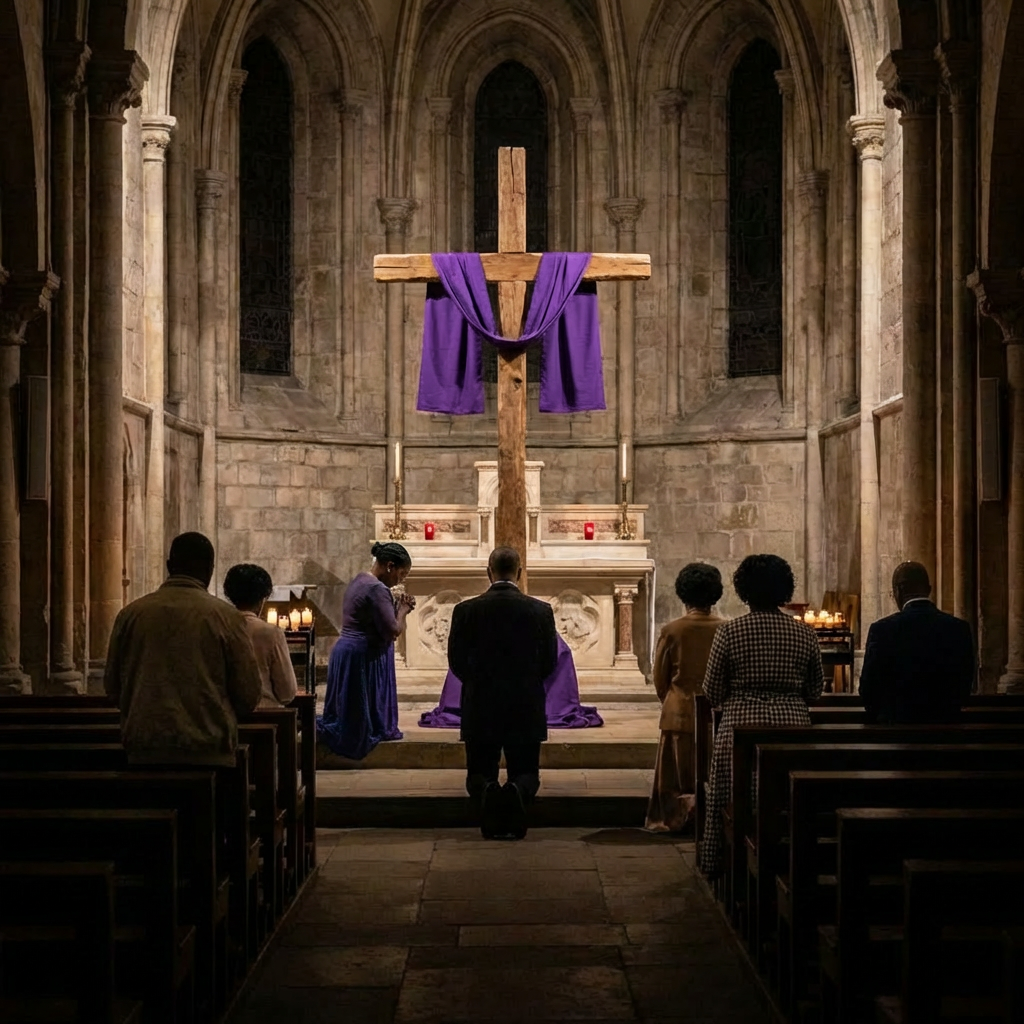
People praying in a stone cathedral before a wooden cross draped in purple cloth.

It’s Holy Week. Today is Good Friday…

“And Jesus said, ‘Father, forgive them, for they know not what they do.’” ~ Luke 23:34

The most destructive displays of sin are often hidden in the brutality we inflict on one another—in words and in deeds. In the warring and the verbal assault. In the hatred and venom we cloak in self-righteousness. We use God’s Word as a window to judge others, rather than as a mirror to examine our own hearts—our ignorance and our complicity.

Good Friday causes us to linger where we would rather rush past: the suffering of the Innocent and the sin of the guilty. In Luke’s telling, Jesus does not wait for the world to understand Him before He loves it. While the injustice is still happening, Jesus speaks:

Father, forgive them for they know not what they do.

Not because they are innocent—but because sin blinds us. It sears the conscience, baptizes cruelty as “duty,” and convinces us our anger is righteous and our hands are clean.

So when we hear Jesus utter—amid His suffering—the compassionate plea, “Father, forgive them…,” we envision the soldiers who crucified Him; the priests who condemned Him; the magistrate who washed his hands; and the crowds who went from cheering to jeering in a matter of days. We hear the laughter and taunts—the smug satisfaction of those who think they have silenced Him.

There is a “them” of power, a “them” of piety, a “them” of the crowd—and a “them” of silence.

Jesus says from Calvary’s cross: Father, forgive them

Who is this “them” for whom Jesus intercedes?

Who is this “them” to whom Jesus commends forgiveness?

Who is this “them” that compels Jesus to stop dying—just long enough—to breathe out blessing?

And while staring through this glass, dimly, I realize: what I first perceived as a window is actually a mirror. The cross is not only about what they did long ago; it exposes what sin still does in us—how we wound and justify, exclude and spiritualize, stay silent and excuse.

The ‘them’ to whom Jesus surrenders His hands and His feet…

The ‘them’ for which Jesus bows His head…

The ‘them’ for whom Jesus intercedes…

This “them” is not a “them” at all…

This ‘them’ is us…

This ‘them’ is you…

This ‘them’ is me…

It’s me when I choose convenience over courage.

It’s me when I choose comfort over character.

It’s me when I would rather be right than be reconciled.

It’s me when I can live with somebody else’s suffering—as long as it doesn’t disrupt my peace.

Amid intense pain, overwhelming grief, and sorrowful isolation, Jesus gives His dying breath to declare grace upon those who conspired, colluded, or were complicit in His suffering.

Jesus does not pretend the nails are not nails, and He does not call evil “good.” He tells the truth about what is being done to Him—and then He prays anyway.

This is not optimistic denial. Jesus breaks the cycle of sin by declaring grace and embodying mercy in the face of reality.

Father, forgive them… for they know not what they do…

Father, forgive us…

Father, forgive me…

For insolence—when we behave like we are beyond reproach. For individualism—when we forget we belong to each other. For insularity—when our circle gets so small that compassion can’t get in.

For isolation—when we retreat and call it “peace.” For inconsideration—when we resist acknowledging who we’ve bruised. For egotism—when everything must revolve around us. For ignorance—when we refuse to know, because knowing would require change.

Jesus entreated the Father for grace…

Before we confess it right. Before we feel it deeply. Before we fix what we broke. Before we ever find the words— Jesus finds the prayer.

Father, forgive them…

So, for a moment, let’s not rush. Let’s not rationalize. Let’s not become defensive. Let Jesus’ prayer land where He intended.

Father, forgive them…

He offered before we ask,

He offered beyond our actions,

He offered even when we were at our worst,

He offered—without regard for the cost—

Forgive them…

Forgive us…

Forgive me…

For they, weI know not what I do…

The haunting image of our Suffering Savior

Pierces me through to my very soul…

When turning aside in horror,

In my own hands I behold

The hammer and the nails,

I hold.

Father… Forgive them?

Father, forgive us…

Father, forgive me…

Especially when we don’t know what we are doing.

Good Morning, I love you all!

ihs

just adam

Commandment Thursday?

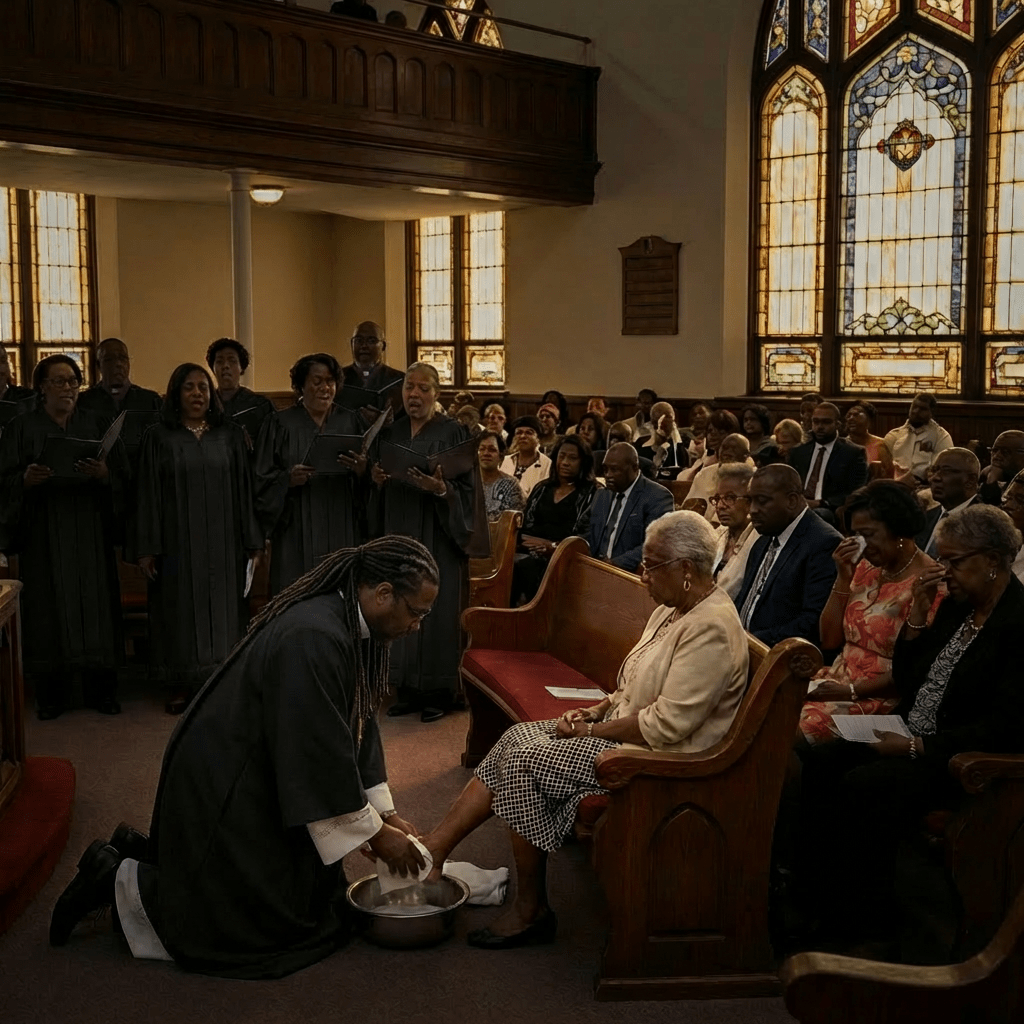
Minister washes feet during service with text MAUNDY THURSDAY: LOVE ONE ANOTHER.

It’s Holy Week…

These are the days when the Church slows down long enough to watch, listen, and remember what our salvation cost.

Jesus gathered His disciples to observe the Passover. The room held familiar rhythms of the feast—bread, cup, story, promise—until, in the middle of the meal, Jesus stood up. He took off His outer garment, wrapped a towel around His waist, poured water into a basin, and moved toward dirty feet. Some were repulsed by what He was doing; Peter resisted and initially refused—to which Jesus replied:

“Unless I wash you, you have no share with me.” 

John 13:8

Jesus humbles Himself as a demonstration of confidence—the aim of the Incarnation—and a prefiguring of the ultimate display of humility in His ensuing Passion. The towel points to the cross. The water basin anticipates His shed blood. The One who stoops to wash their feet will soon stretch out and surrender His hands to save the world.

As Jesus removes His outer garment and assumes the role of a servant, we witness the confidence of the One who knows who He is—and whose love is so settled, so sure, that it can afford to kneel. Can you hear Jesus saying:

“For this reason the Father loves me, because I lay down my life in order to take it up again. No one takes it from me, but I lay it down of my own accord. I have power to lay it down, and I have power to take it up again. I have received this command from my Father.”

John 10:17-18

This is the sureness of heart beneath the stooping posture: Jesus is not being diminished by service; He is revealing Himself through it. Because He belongs to the Father, because His life is held in the Father’s hands, He is free to take the lowest place without fear. That is confidence—and it always looks like humility.

So, what?

We might think it’s enough that Jesus has done all these things for us—and it is our only hope. Yet Jesus also requires these things of us. Not as a way to earn His love, but as the shape His love takes when it finally reaches our hands and feet.

Hence, we observe Maundy (Commandment) Thursday—because Jesus’ humility is not merely something we admire; it is something we are called to imitate:

“For I have set you an example, that you also should do as I have done to you.”

John 13:15

May we possess the confidence that cultivates humility—and the humility that enables us to serve others with love,dignity, patience, and joy.

Good morning, I love you all!

ihs,

just adam

And the Blind and the Lame Came to Him

It’s Holy Week.

After Jesus expelled the moneychangers from the temple, the blind and the lame came to Him there—and He healed them.

There is something striking about the order of events in the text. Jesus enters Jerusalem on Palm Sunday. He goes straight to the temple. And only after the temple has been purged—only after the clutter and corruption have been confronted—do the blind and the lame come forward, and Jesus heals them.

It’s amazing what kind of healing becomes possible when distractions are removed. How often the very things meant to mediate God’s presence instead obstruct it. How often clutter crowds out compassion. And yet, when space is cleared, when barriers are dismantled, those who were once blind begin to see, and those who were once unable to walk find their footing again. Amazing grace, indeed.

What begins as a bold and prophetic act—Jesus overturning tables—quickly becomes an occasion for ministry. Real help. Real healing. The disruption is not an end in itself; it makes room for restoration.

In ancient Israel, the blind and the lame would not have been welcomed in the temple. The rules, the rituals, the systems meant to order worship had become stumbling blocks rather than steppingstones. Look at what Jesus does. He does not reinforce the barriers; He removes them. And when He does, those who had long been excluded are finally able to come near.

This is not just a word about the temple, per se. It is a word about our hearts and our lives.

What things must Jesus disrupt in us? What needs to be dismantled, decluttered, overturned, so that healing might take place? Where are we struggling to see—to stand—to walk? What is obscuring our vision or hindering our steps? What is leaving us unsteady, unstable, unfulfilled, and unhealed?

May God disrupt anything that hinders healing—whether for others or for ourselves.

“And the blind and the lame came to Him in the temple, and He healed them.”
Matthew 21:14

Good morning. I love you all.

ihs,
just adam

Flipping Tables?

It’s Holy Week.

Yesterday was Palm Sunday, when we celebrated Jesus’ triumphal entry into Jerusalem. With throngs going before Him and following behind Him, the people worshiped and praised God.

As He entered the city, Jesus made a beeline for the temple.

And there—His first encounter—were the moneychangers and those selling sacrifices to would‑be worshipers.

Jesus flipped the tables.

He upended their economy.
He disrupted their dealings.
He exposed a system that had turned worship into a transaction rather than an occasion for transformation.

Jesus flipped the tables—driving out those whose theology had been corrupted by thievery; those who exchanged God’s glory for material gain; those whose god was their belly, who glory in their shame, with minds set on earthly things (Philippians 3:19).

We like this Jesus, don’t we?

The Jesus who enters the temple.
The Jesus who flips the tables.

He may not be quite what we expect from the One we call the Prince of Peace—but we like that Jesus… until it’s our table being flipped.

You see, there is no peace where lies—even the subtlest deceptions—are allowed to set up shop and conduct business as usual. So Jesus turns over the tables in the temple.

And according to Scripture, we are temples of the LORD—yes?

So then, what tables need to be flipped in our hearts?
What strongholds need to be torn down?
What idols need to be exposed and expelled?

Yes, Jesus is indeed the Prince of Peace—but His peace is no easy peace. It is the only true and enduring peace, and it begins—always—grounded in Truth and tough Love.

“And Jesus entered the temple and drove out all who sold and bought in the temple, and He overturned the tables of the money‑changers and the seats of those who sold pigeons.”
Matthew 21:12

Good morning. I love you all.

ihs,
just adam

Please Be Kind to Yourself.

All of us make mistakes. We have shortcomings. But none of us are defined by our worst days. We’re shaped by what failure teaches us, but we are not failures.

Please hear this Truth today:

You are God’s beloved, and that is the Truth that matters.

And since we are still here, we are living, breathing proof that God is not through with us—God has not abandoned us, forsaken us, or condemned us.

While God continues to perfect us, God’s love toward us is already perfect—meaning we can do nothing to make God love us any more or any less.

You are God’s beloved, and that is the Truth that matters.

Regardless of our performance—what we’ve done or left undone—God will not repent of God’s love or gracious calling.

You are God’s beloved, and that is the Truth that matters.

So please, brothers and sisters, remember this Truth. Recite these words to yourself. And—

Be kind to yourself!

But God demonstrates His own love toward us, in that while we were still sinners,

Christ died for us.

(Romans 5:8)

Good Morning, I love you all!

ihs,

just adam

In Your Light, We See Light.

This morning when I woke up, despite the frost on the grass, the sun was shining brightly and the birds were singing—as if they were welcoming the light of the new day.

In Your light we see light. 

I will yield to their witness. 

Despite the cold darkness—and the conflicts and wars gripping our world—beyond the pervasive suffering that would dare stifle joy and mute any inclination toward hopefulness, I will join the chorus of creation in welcoming this new day—   

In Your light we see light. 

I will sing to encourage my soul. 

In Your Light we see light.

God’s presence will center me.

In Your Light we see light.

Will you join me in singing a new song this morning?

7 How precious is Your lovingkindness, O God!

Therefore, the children of men put their trust under the shadow of Your wings.

8 They are abundantly satisfied with the fullness of Your house,

And You give them drink from the river of Your pleasures.

9 For with You is the fountain of life.

In Your light we see light.

Psalm 36:7-9

In Your light we see light…

In Your light we see light…

In Your light we see light…

Good Morning, I love you all!

ihs, 

just adam

Everywhere You Go? (3)

Everywhere You Go? (3)

God’s grace, wisdom, and power are with us everywhere we go—everywhere we go! At home, in traffic, at the market, on the job, in the hospital room – everywhere we go – every place we chose – and even the places we should not have – God is with us everywhere we go!

And yet, it is a tragedy that we move through life feeling alone, inept, confused, and overwhelmed, often forgetting that the God of our past is also the God of our present and the God of the future.

How often do we resist God’s grace, wisdom, and power?

How often do we miss the blessings and benefits of God’s presence?

When we pray… when we meditate on God’s Word… when we yield to the Spirit’s presence—these are all ways we acknowledge God is with us. And when we acknowledge Him, we gain access the grace, wisdom, and power that was always available and proven to be everything we need.

The Proverb writer reminds us:

In all thy ways acknowledge Him, and He shall direct thy paths.

Proverbs 3:6

God is with you—everywhere you go.

You already have everything you need.

Now, live like it.

Good Morning, I love you all!

ihs,

just adam

Everywhere You Go (2)

Since God is with us—everywhere—we can have confidence regardless of the circumstances.

There is no place we can go where God is not.

This is a comfort, but for me, it also comes with conviction.

There is no place we can go where God is not.

When stress causes me to feel like God has forgotten me,

when anxiety compels me to worry,

When temptation presses me to hide my face,

I remember.

There is no place we can go where God is not.

This is comfort—sometimes conviction—but ultimately a reminder that I am connected.

There is no place we can go where God is not.

In strength or in weakness, in success or in failure—whether up, down, sideways, or backwards—God is present—grace is present.

There is no place we can go where God is not.

This grace challenges and convicts, comforts and chastens, consoles and checks us.

This grace calls us and comes after us relentlessly—and this is Good News!

The Psalm writer says it like this…

4 For there is not a word in my tongue, but, lo, O Lord, thou knowest it altogether.

5 Thou hast beset me behind and before, and laid thine hand upon me.

6 Such knowledge is too wonderful for me; it is high, I cannot attain unto it.

7 Whither shall I go from thy spirit? or whither shall I flee from thy presence?

8 If I ascend up into heaven, thou art there: if I make my bed in hell, behold, thou art there.

9 If I take the wings of the morning, and dwell in the uttermost parts of the sea;

10 Even there shall thy hand lead me, and thy right hand shall hold me.

11 If I say, Surely the darkness shall cover me; even the night shall be light about me.

12 Yea, the darkness hideth not from thee; but the night shineth as the day: the darkness and the light are both alike to thee.

Psalm 139:4-12

Say it with me:

“There is no place I can go where God is not.”

Good morning. I love you all.

ihs,

just adam

Everywhere We Go?

Did you know that much of what we, as Christians, cherish as Scripture in the New Testament was written by the Apostle Paul while he was imprisoned—under house arrest?

Let that sink in.

Some of the most encouraging and hope-filled words we quote so easily were penned by someone living under restriction, sacrifice, and persecution. Paul did not write from a place of comfort or ease, but from confinement.

Philippians is often called the epistle of joy. It’s the letter that gives us those familiar, strengthening words:

“I can do all things through Christ who strengthens me.” (Philippians 4:13)

Paul’s life reminds us of something essential: our faith in Christ determines our disposition—not our circumstances. His joy wasn’t rooted in freedom, success, or favorable conditions. It was grounded in Christ.

Paul shows us that even when life is far from ideal, confidence in Jesus allows us to preserve our integrity and protect our peace. When we acknowledge Christ’s presence and trust God’s sovereignty, we can remain resilient and hopeful. With the Spirit comforting us, we can stay confident—even in crushing circumstances.

And because of that, we can be faithful witnesses wherever we are. No matter what’s going on. No matter who’s around us. Even in difficult seasons, God can use us to have an unexpected influence and a positive impact.

Listen to how Paul viewed his own situation:

“I want you to know, brothers, that what has happened to me has really served to advance the gospel, so that it has become known throughout the whole imperial guard and to all the rest that my imprisonment is for Christ.”
Philippians 1:12–13

Paul understood something powerful: Jesus was with him. The Spirit was at work. God’s providence had not paused because of prison walls.

Christ was present—everywhere he went.

May we carry that same awareness today. Wherever we find ourselves, may we trust that God is still working, still strengthening, and still using us for His glory.

Good Morning, I love you all!

ihs,

just adam

Clean Inside? (4)

At the risk of sounding redundant, it bears repeating again and again: while we often scrutinize how things appear, the Creator searches our hearts.

All that is seen is made up of that which is unseen. Integrity and faithfulness are always inside jobs. While our actions do, in many ways, reveal our motives and our most prominent desires, they can just as easily belie our intentions.

In a few words—we can and often will do what seems right for the wrong reasons. Greed and selfishness masquerade as drive and ambition. Pride and avarice present themselves as confidence and acumen. Cruelty and harshness are mislabeled as strength and conviction. Self‑deprecation and insecurity disguise themselves as humility and meekness. And, most disturbingly of all, sometimes only God knows the difference.

Some of the most consistent and unfortunate lies are the ones we tell ourselves. Thankfully, we are not left alone—the LORD has given us His help: the Holy Spirit, who sensitizes us, exposes our self‑deceptions, and frees us from them.

The psalmist must have known this when he declared:
“O Lord, You have searched me and known me…” (Psalm 139:1)

Do you see again how the Word and the Spirit collaborate to make us clean on the inside?

While we are often absorbed with and enamored by aesthetics, the God who makes all things beautiful in their time also desires truth in the inward parts.

Get it?

Are you ready to get clean on the inside?

Pray with me:
Create in me a clean heart, O God,
and renew a right spirit within me.
—Psalm 51:10

Good morning. I love you all.

ihs,
just adam